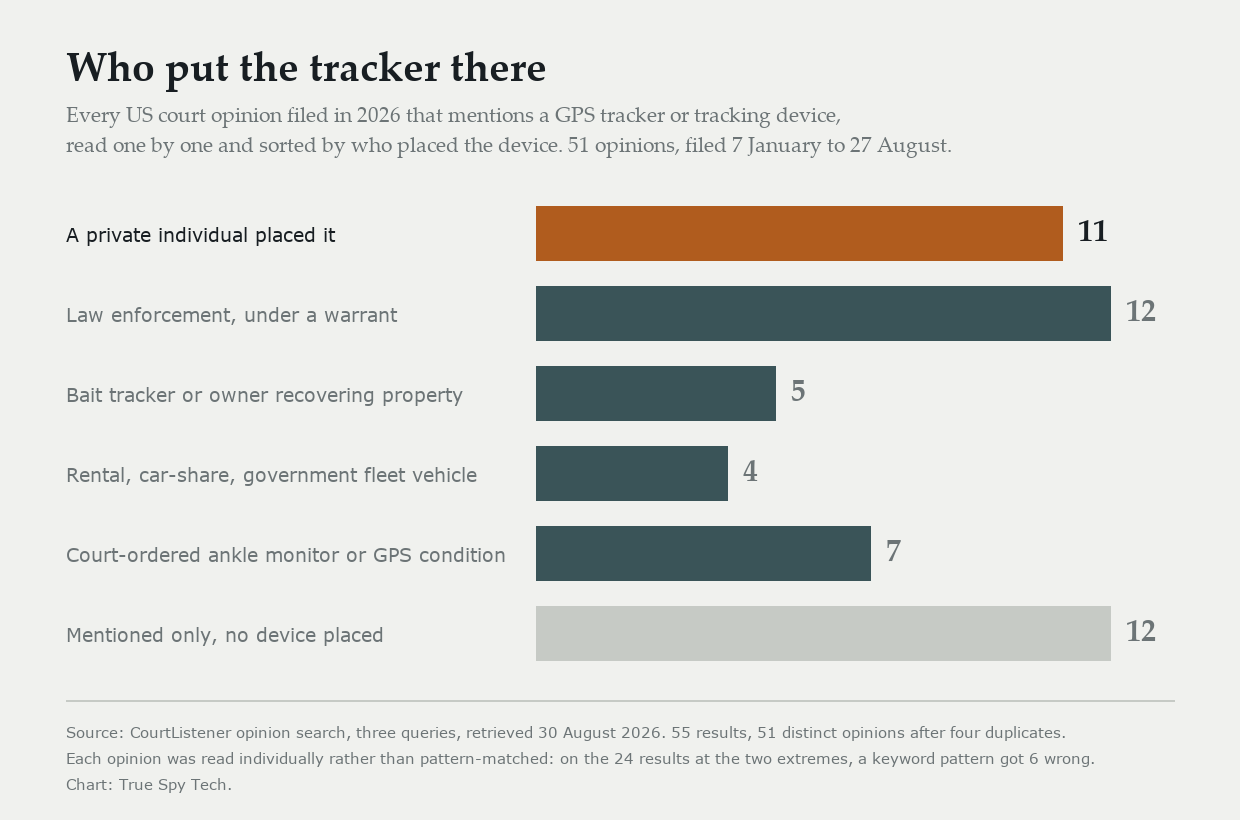
Search a US case-law database for the words “GPS tracker” and you get a pile of opinions that look like they are all about the same thing. They are not. Between 7 January and 27 August 2026, federal and state courts published 51 opinions that mention a GPS tracker or a tracking device. We pulled every one of them and read them individually. In 11 of the 51, a private person had put a device on somebody else without their knowledge. In 9 of those 11, the two people were partners, ex-partners, or the parents of the same child.
That is the whole finding, and the rest of this article is what sits under it.
What the 51 opinions are actually about
The single largest group is police work. In 12 opinions a law enforcement agency attached a tracker to a vehicle, almost always under a warrant, and the appeal turns on whether the warrant was good. Behind that come the 11 private placements. Then 7 opinions about court-ordered GPS, which is to say ankle monitors worn as a condition of probation or supervised release, and 5 about bait trackers or an owner following stolen property. Four involve a vehicle whose owner is a rental company, a car-share service or a state agency, where the tracker was already in the car before anyone thought about surveillance.
And 12 opinions mention a tracker without one ever being placed. A dog-sniff case cites the leading Supreme Court tracker precedent by analogy. A Maryland opinion quotes the phrase “tracking device on stolen tags” because it was a search query pulled off a defendant’s phone. An Oregon opinion uses “tracking device” to describe a packet sniffer with a directional antenna, which has nothing to do with GPS. If you were counting by keyword rather than reading, roughly a quarter of your dataset would be noise.
The eleven
Strip away the police warrants, the ankle monitors and the noise, and 11 opinions are left in which a private individual placed a tracking device on another person’s vehicle. They are worth listing by what actually happened, because the pattern is not the one the product marketing suggests.
A father in Ohio, in a custody dispute, waited in the parking lot of a WIC office and, by his own admission at trial, paid a man to tell the mother of his child that her tire was flat so that she would stay put. While she was inside, he placed a GPS tracker on her car to learn her home address. He recorded himself doing it. The juvenile court used that footage, which he had offered as evidence in his own favour, in the findings that supported a civil protection order against him.
In Iowa, a man placed an Apple AirTag in a magnetic puck under the boot of a woman’s car. In Rhode Island, a GPS unit sat inside a small plastic container affixed to the underside of a Toyota Venza whose driver was shot dead nine days after the device was switched on. In Texas, a man who had already completed probation for assaulting his ex-wife and for violating a protective order drove past her work and her home, left her eight voicemails over six weeks, and put a tracker in her car. In Ohio again, a father in another custody fight had his own mother buy the tracker for him so that it would not be bought in his name.
Two of the eleven are thinner than the others and we are counting them with a caveat. A Texas opinion records an uncle testifying that the defendant “found a tracking device in his truck”, which tells you a device existed without the court deciding who put it there. A Sixth Circuit asylum opinion records a mechanic finding a tracker on a truck during repairs, and those events happened in Brazil, not the United States. Nine of the eleven are US courts making findings about conduct in the US. We would rather write that sentence than round the number up.
Nobody in this dataset was tracked by a stranger
This is the part that should change how you think about the risk. The consumer conversation around trackers is framed around strangers: the person who follows you out of a car park, the thief scouting your vehicle. Not one of the 11 opinions describes that.
Every single one involves somebody who already knew the person’s name. Ex-partners in four. Co-parents in a custody dispute in two. A husband and wife in the middle of a divorce in one. A live-in partner in one. A family feud over a real-estate contract in one. A homicide in which the person tracked and the people who tracked him were not strangers either.
The practical consequence is unpleasant and specific. A device planted by someone who knows you does not need to be hidden well, because that person has repeated, unsupervised access to your car. They know when you sleep. They know where you park. They can retrieve the device and replace its battery, which is why one of these cases involves a tracker that had been running for months rather than days. Advice built around detecting a hurried roadside placement is aimed at the wrong scenario. If you want the physical version of this, our guide to where trackers actually get hidden on a car is organised by how long the person had access, not by how clever the hiding place is.
How they were found
The discovery methods in these opinions are mundane, and none of them involved buying anything.
In the Iowa case, the woman had already worked out that the man knew her locations without being told. A friend showed her how to switch on unknown-AirTag alerts on her iPhone. The next time she walked to her car, her phone told her an AirTag was moving with her. She and several friends searched the vehicle until they found it wedged in a magnetic puck on a support beam under the boot.
In Rhode Island, nobody found the device at all until the car was towed to police headquarters after a shooting and taken apart by a detective. In the Sixth Circuit case, a mechanic doing unrelated repairs noticed a stranger approaching the truck, went to look, and found the tracker. In the Texas protective-order case, the pattern of the man appearing where she was came first and the device was found second.
That ordering repeats. In most of these opinions the person did not find a tracker and then infer they were being followed. They already knew they were being followed, from messages that revealed too much or from someone turning up where they had no reason to be, and the search came afterwards. The phone alert helped once. A methodical physical search, which we set out step by step in how to check a car for a GPS tracker, did the rest.
Trackers are traceable in both directions
Here is the finding that anyone considering placing a device should sit with for a moment.
In the Iowa case, the man admitted to a deputy that the AirTag would be registered to him through Apple, and Apple’s records confirmed it. In the Rhode Island case, the detective sent the recovered unit to a colleague who went to the manufacturer and got back the name of the person who had bought it, along with the date it was activated. The device and its container were also swabbed for DNA. In the Ohio custody case, the father’s attempt to launder the purchase through his mother is in the opinion because the court knew who had bought it.
A GPS tracker is a radio that has to be sold, registered and activated. Every one of those steps leaves a record with a name attached, and every one of those records is reachable with a subpoena. In none of these opinions did the identification of the purchaser take any real investigative effort.
What happened to the people who placed them
The outcomes vary far more than the conduct does, and the variation is mostly about which statute the prosecutor reached for.
The strongest outcome in the set is the Iowa case. The state charged stalking by use of a technological device under Iowa Code section 708.11(3)(a)(4), a jury convicted, and the district court imposed a ten-year prison term, suspended, with three years of probation. The conviction and sentence were affirmed on appeal. That is a felony record built on one AirTag.
The Texas case produced a thirty-year protective order, upheld on appeal, alongside a criminal stalking charge and an emergency order of protection granted by a magistrate. In Idaho, an ex-girlfriend reported to police that she believed a man had put a tracking device on her car and a listening device in her home. That report produced a warrant for his phone. What was on the phone produced six video voyeurism convictions and, in a second docket, life imprisonment with a twenty-five year minimum for burglary, further voyeurism counts and sexual exploitation of a child. The tracker was never the case. It was the thread that started it.
Now the counterweight, because the record is not one-sided. In Tennessee, plaintiffs sued a woman under federal and state wiretapping statutes over surveillance devices. It went to a two-day jury trial. The jury found for the defendant, the trial court entered judgment for her, the plaintiffs’ motion for judgment notwithstanding the verdict was denied, and the Court of Appeals affirmed. A civil claim of this kind is a real trial with a real burden of proof, and it can be lost.
Criminal exposure in these cases came from stalking and harassment statutes rather than from any law about trackers as such. Which statute applies to you depends entirely on your state, and the ground moves: our state-by-state breakdown of GPS tracking law covers where consent is required and where a marital vehicle changes the answer. The most common question we get, whether a parent may track a teenager’s car, has its own answer in the rules on tracking a teenager, and it is not the blanket yes that most people assume.
What we would take from this
If you think you are being tracked, the useful signal is almost never the device. It is the pattern of someone knowing things they should not know. In this record, the pattern came first nearly every time and the device turned up afterwards. Our counter-surveillance guide starts from that premise rather than from a hardware checklist.
If a device is found, leaving it in place and calling the police is what produced the strongest evidence in these opinions. Photographs of the device where it sat, and the vehicle preserved rather than cleaned, are what the Rhode Island detective had to work with. A tracker pulled off and binned proves nothing about who put it there.
If the vehicle is jointly owned or jointly titled, do not assume that settles anything. Several of these opinions involve a car that both people had some claim to, and the Iowa defendant argued exactly that, telling investigators the vehicle was legally half his. He was convicted of stalking anyway. Ownership of the car and consent to be followed are separate questions, and the statutes that bit hardest here were about the following, not the hardware.
And if you are on the other side of this, thinking about putting a device on a car that is not entirely yours, the eleven opinions above are what that looks like from the far end. A felony record. A thirty-year protective order. A phone warrant that turned up things nobody had gone looking for. The device names its buyer.
How this was counted
The corpus came from the CourtListener opinion search on 30 August 2026, using three queries covering “GPS tracker”, “GPS tracking device” and tracking devices in a vehicle context, restricted to opinions filed in 2026. That returned 55 results. Four are duplicate clusters of two opinions that were filed once and indexed more than once, one of them a Fourth Circuit opinion appearing under four separate defendant names, leaving 51 distinct opinions. The full text of all 55 came to just over three million characters, and all 55 were read.
Sorting them was done by hand, one opinion at a time, because the obvious alternative does not work. As a check on that, we built a keyword pattern that looks for a placement verb next to a tracker noun, ran it against the 24 results at the two extremes of the set, the 11 private placements and the 13 in which no device was placed at all, and compared it against the hand reading. The pattern agreed on 18 of 24. It missed five private placements, including one whose text reads “a tracking device Michael had placed on her vehicle”, because words sat between the noun and the verb where the pattern did not expect them. It produced one false positive on an opinion that merely quotes the phrase “installation of a GPS device” from an earlier case. A pattern that is wrong on a quarter of the cases at the extremes would be far worse in the ambiguous middle, which is why there is no pattern in the numbers above.
Two limitations. Published appellate opinions are a filtered sample: they represent disputes that were serious enough to be charged or sued over, appealed, and then published. They cannot tell you how often trackers are planted, only what it looks like when the conduct reaches a court that writes things down. And the category boundaries involved judgement calls, five of which were genuinely close and were resolved by pulling wider passages of the opinion rather than by rule.
Nothing here is legal advice. The statutes cited are quoted from the opinions themselves, and every case named is a published decision that anyone can pull up on CourtListener and check against what we have written.
Behind this review
TrueSpyTech does not operate a test lab, and no article here rests on a unit we plugged in ourselves. Research pulls the spec sheets and the relevant law, the pattern in owner reports fills in what a spec sheet will not admit, and an editor signs off before anything goes live. Ratings are locked before affiliate links go in, never after. The full protocol is on our How we review page.
Google lets you pick which sites come up first in your own results.