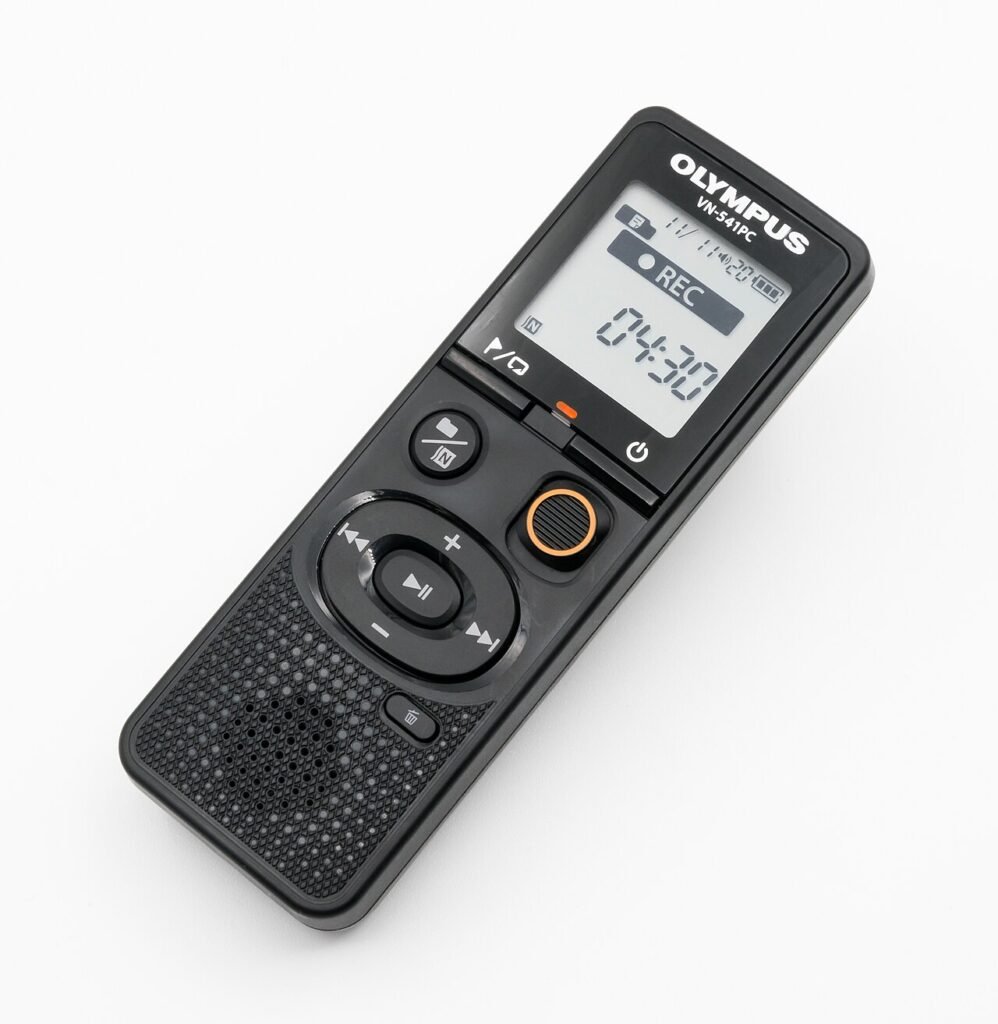
A voice recorder is legal to own and legal to use in every US state. Whether it’s legal to press record on a specific conversation depends on where you’re standing: 38 states plus DC only need one person in the conversation, meaning you, to know it’s being recorded. The other dozen or so require every single person on the call or in the room to agree first. Get that part backwards and the best recorder in the world won’t save you from a wiretapping charge.
That legal split matters more than any spec sheet, but it isn’t the only question people ask us. The second most common one is simpler: which recorder should I actually buy. Both questions get a full answer below, starting with the law because it changes what you should even be shopping for. Someone recording lectures for personal study needs a different device, and faces a different legal question, than someone documenting a landlord dispute or a source interview.
Verdict
The Sony ICD-UX570 is the recorder we’d tell a friend to buy: strong built-in mics, a battery that survives a full day of back-to-back meetings, and USB playback without extra software. Students and journalists who need cleaner audio in noisy rooms should look at the Zoom H1n instead. Neither one makes recording legal on its own, so read the consent section below first.
This guide covers both halves of the problem: which states let you record with just your own consent, and which recorders are worth carrying around. We’ll link out to the state-by-state breakdowns for specific use cases (phone calls, work meetings) rather than trying to cram every statute into one page, since each of those situations has its own wrinkles that deserve more than a paragraph.
Is it legal to record someone with a voice recorder?
Yes, in most of the country, as long as you’re a participant in the conversation. That’s the one-party consent rule, and it covers 38 states plus the District of Columbia. If you’re on the call or in the room, you can hit record without announcing it. The remaining states, including California, Florida, Illinois, and Washington, require all-party consent: everyone being recorded has to know about it and agree, not just you. We break down which states fall into each group in our one-party vs. two-party consent breakdown, and the broader legal picture, including how federal law interacts with state law, lives in our surveillance and recording laws overview.
A recorder sitting in a drawer commits no crime. The legal exposure shows up the moment you press record on a specific person in a specific state, so treat “is this legal” as a per-conversation question, not a one-time check you do when you buy the device.
Federal law adds one more layer that’s worth understanding even if you never leave your home state. The Federal Wiretap Act sets a nationwide floor of one-party consent, meaning no state can legalize recording with zero party consent. States are only allowed to raise that bar, which is exactly what the all-party states have done. So when someone tells you “it’s legal because of federal law,” they’re only half right: federal law sets the minimum, but your state’s law is usually the one that governs the conversation you’re having.
What matters when you’re buying one
Most voice recorders in the $40 to $120 range record fine in a quiet office. The differences show up in three places: how the built-in mics handle a noisy room, how long the battery lasts without you thinking about it, and whether the files come off the device in a format your transcription software likes.
Storage and battery life are the two specs worth caring about before you compare anything else.
File format matters more than people expect once transcription enters the picture. A recorder that only saves in a heavily compressed format can make an otherwise clean recording harder for transcription software to parse correctly, especially with overlapping speakers or background noise. WAV and higher-bitrate MP3 both transcribe more reliably than low-bitrate files, and most mid-range recorders let you choose the format in the settings menu before you ever hit record. It’s worth checking that setting the first time you use a new device rather than discovering the wrong format halfway through a semester of lecture notes.
Mic type is the other thing spec sheets tend to bury. Built-in stereo mics, the kind on the Sony and the Olympus in the table below, work well in normal-sized rooms and one-on-one conversations. An X/Y stereo capsule, like the one on the Zoom, does noticeably better job separating multiple speakers in a panel or group setting, which is why podcasters and journalists covering roundtables tend to prefer it even though it costs a bit more in convenience.
| Model | Battery life | Storage | Best for |
|---|---|---|---|
| Sony ICD-UX570 | ~35 hrs recording | 4GB built-in + microSD | Meetings, interviews, general daily use |
| Zoom H1n | ~10 hrs (2x AA) | microSD, up to 32GB | Podcasters, music, cleaner room tone |
| Olympus WS-852 | ~78 hrs recording | 8GB built-in + microSD | Students, lecture capture, budget buyers |
| Tascam DR-05X | ~17.5 hrs (2x AA) | microSD, up to 128GB | Field journalists, long unattended recordings |
Voice activation (the recorder pauses itself during silence) sounds like a battery-life feature, but it’s mostly a storage-management one. It stops a two-hour lecture from eating a gigabyte of dead air. Most journalists we’ve talked to on forums leave it off for interviews, because the pause-and-resume can clip the first syllable after someone starts talking again.
Build quality and button layout matter more once you’ve used one of these for a few weeks. A recorder with a physical record button you can press without looking, ideally with a distinct click or a slight resistance, saves you from fumbling in a bag or a pocket during a meeting that’s already started. Menu-driven controls tend to be fine for setup but frustrating mid-conversation, so if you can test one in a store before buying, pay attention to how the record function itself feels rather than how the settings screens look.
Price tends to track battery life and mic quality more closely than brand name. Budget models under $50 usually cut corners on one of three things: mic sensitivity in noisy environments, battery life, or build durability. None of those are dealbreakers for occasional use, but they compound if you’re recording daily.
The recorders worth buying
Sony ICD-UX570
BEST OVERALL
- Two built-in stereo mics, good separation in a mid-size room
- USB arm flips out, no cable needed to transfer files
- Noise-cut function helps in a coffee shop, not just marketing copy
Zoom H1n
BEST AUDIO QUALITY
- X/Y mic capsule pulls it well above phone-recorder quality
- Runs on standard AA batteries, easy to top up anywhere
- No built-in storage, always bring a microSD card
Olympus WS-852
BEST BUDGET PICK
- Battery life that outlasts a full semester of lectures on one charge cycle
- Basic scene modes, nothing fancy, but they work
- Mic sensitivity drops off past the front few rows of a large room
Voice recorder or just use your phone?
A phone handles a two-minute voice memo fine, and for most people, most of the time, that’s genuinely all they need. The case for a dedicated recorder starts once you’re recording regularly, need battery life the phone can’t spare because you’re also using it for other things, or need audio clean enough that transcription software doesn’t choke on it. A recorder also doesn’t tempt you to glance at notifications mid-interview, which sounds minor until you’ve watched it derail a source’s train of thought.
The tradeoff runs the other way too. A phone is something you already carry, so there’s no extra device to remember, charge separately, or lose. If your recording needs are occasional, a stray meeting here, a lecture there, the built-in recorder app on any modern phone is genuinely good enough, and spending $60 to $120 on a dedicated device solves a problem you don’t have.
Where people run into legal trouble
Two situations account for most of the “can I record this” questions we get: work meetings and phone calls. Neither one has a single universal answer. A one-party consent state lets you record your own performance review without telling your manager, but your employer’s own policy or an NDA you signed can still make that a firing offense even where it’s not a crime. We walk through that split in detail in can you record a work meeting without telling anyone.
Phone calls add another wrinkle: federal law sets a one-party consent floor, but if either party is physically in an all-party state, that stricter rule can apply to the whole call. Our state-by-state phone call breakdown lays out exactly which states raise the bar above the federal minimum.
If your use case is journalism or research interviews specifically, jump straight to our picks for journalists and students, since battery life and transcription-friendly audio matter more there than they do for a quick meeting note.
A third scenario worth mentioning briefly: recording in public spaces, like a lecture hall, a public meeting, or a store. Most one-party and all-party distinctions still apply based on where the conversation is happening and whether there’s a reasonable expectation of privacy, but a genuinely public setting, like a city council meeting open to anyone, generally carries less legal risk than a private conversation would. That said, “generally” is doing real work in that sentence, so don’t treat a crowded room as automatic legal cover.
Getting the most out of whichever recorder you pick
A few habits make a bigger difference to recording quality than the device itself. Keep the recorder within a couple feet of whoever’s talking whenever possible, since distance is the single biggest factor in how clean the audio comes out. Do a ten-second test recording before anything important, since a dead battery or a full memory card only reveals itself at the worst possible moment. And label files as you go, with the date and a short description, because a folder of forty identically named recordings from three months ago is its own kind of nightmare.
Backing up recordings matters more than people think until the one time it doesn’t happen. If a recording might matter later, whether for a workplace dispute, a landlord issue, or just accuracy in a research project, copy it off the device the same day rather than letting it sit as the only copy on a recorder that could get lost, damaged, or accidentally overwritten.
Frequently asked questions
Do I need a special recorder to make audio legally admissible?
No. Admissibility depends on how the recording was obtained (consent law) and how it’s authenticated in court, not on the brand of device. A $50 recorder and a $400 one carry the same legal weight if the recording itself was made lawfully.
Can I record a conversation I’m not part of?
Generally no, not legally, even in one-party consent states. The one-party rule requires that you, the recorder, are a participant in the conversation. Recording a conversation happening near you that you’re not part of moves into wiretapping territory in most states.
Does a voice recorder work as well as my phone for interviews?
A dedicated recorder usually wins on battery life, mic quality in noisy rooms, and not draining the phone you also need for texting and looking things up mid-interview. Phones are fine for a quick two-minute note, less fine for a 90-minute sit-down.
Is it legal to record police during a traffic stop?
In most states, yes, courts have generally treated recording on-duty police performing public duties as protected activity, though the specifics vary and some states carve out exceptions. This is a fast-moving area of law, so check your state’s current statute and recent case law before relying on it.
How long can a voice recorder record on one battery?
Anywhere from 10 hours to nearly 80, depending on the model and whether it’s running on AA batteries or a built-in cell. The Olympus WS-852 in this guide is built specifically for long, unattended sessions like classes and full-day conferences.
Before you buy anything, figure out which consent bucket your state falls into. It changes nothing about which recorder is best, but it changes everything about whether you should press the button.
Behind this review
TrueSpyTech does not operate a test lab, and no article here rests on a unit we plugged in ourselves. Research pulls the spec sheets and the relevant law, the pattern in owner reports fills in what a spec sheet will not admit, and an editor signs off before anything goes live. Ratings are locked before affiliate links go in, never after. The full protocol is on our How we review page.
Google lets you pick which sites come up first in your own results.